
March 31, 2026
Blog: Making Country-Led Malaria Transitions Sustainable
By Isabella Castillo
As global health financing shifts toward greater country ownership, the question is no longer whether transition will happen, but whether it will be sustainable.
Building on the insights of Friends’ recent report in collaboration with Malaria No More U.S. and the United Nations Foundation, Making Country-Led Malaria Control a Reality, a recent panel discussion, organized by Friends of the Global Fight and hosted by Georgetown’s Global Health Institute, featured faith and secular leaders from Zambia, Mozambique, Senegal and Kenya.
Watch the full panel discussion below
Panelists with Dr. Priscilla Lumano Mulenga of the Embassy of Zambia and Joy Phumaphi of the Africa Leaders Malaria Alliance. Photo credit: Georgetown University Global Health Institute
Speakers shared their perspectives on a pressing challenge in global health today: how to sustain progress against one of the world’s deadliest infectious diseases—malaria. At the heart of the discussion was “transition,” the ongoing shift away from donor-led malaria programs toward country-led systems, where governments take on greater responsibility for financing and delivering care. When managed well, this shift can strengthen accountability and sovereignty, but if rushed or underfunded, it can leave critical gaps in prevention and treatment, leading to catastrophic outcomes.
Sustaining progress will require not only new technologies, but also stronger coordination across sectors and deeper engagement with in-country research institutions. Dr. Isabella Oyier, head of the biosciences department at the KEMRI-Wellcome Trust Research Programme and Professor of Molecular Epidemiology at the University of Oxford, emphasized that while malaria mortality has declined by more than 50% over the past two decades, that momentum is now at risk.
Dr. Oyier pointed to the emergence of invasive species Anopheles stephensi as an added challenge for malaria control in Africa, which bears the brunt of the burden. Originally native to parts of South Asia and the Arabian Peninsula, this mosquito has expanded across East Africa in recent years, thriving in urban environments, tolerating high temperatures and demonstrating resistance to many commonly used insecticides. In parallel, growing parasite resistance to antimalarial drugs is making infections harder to detect and treat early.
These shifts, Oyier noted, are heightening the importance of strong surveillance systems, from tracking new mosquito species to strengthening laboratory networks and improving early detection of the malaria parasite. Innovations such as spatial repellents and the use of artificial intelligence to improve testing offer promising pathways, but only if they reach the communities most in need. And while the tools to prevent, detect and treat malaria already exist, including interventions such as insecticide-treated nets and indoor residual spraying that deter mosquitoes, they must be continuously adapted and deployed more effectively.
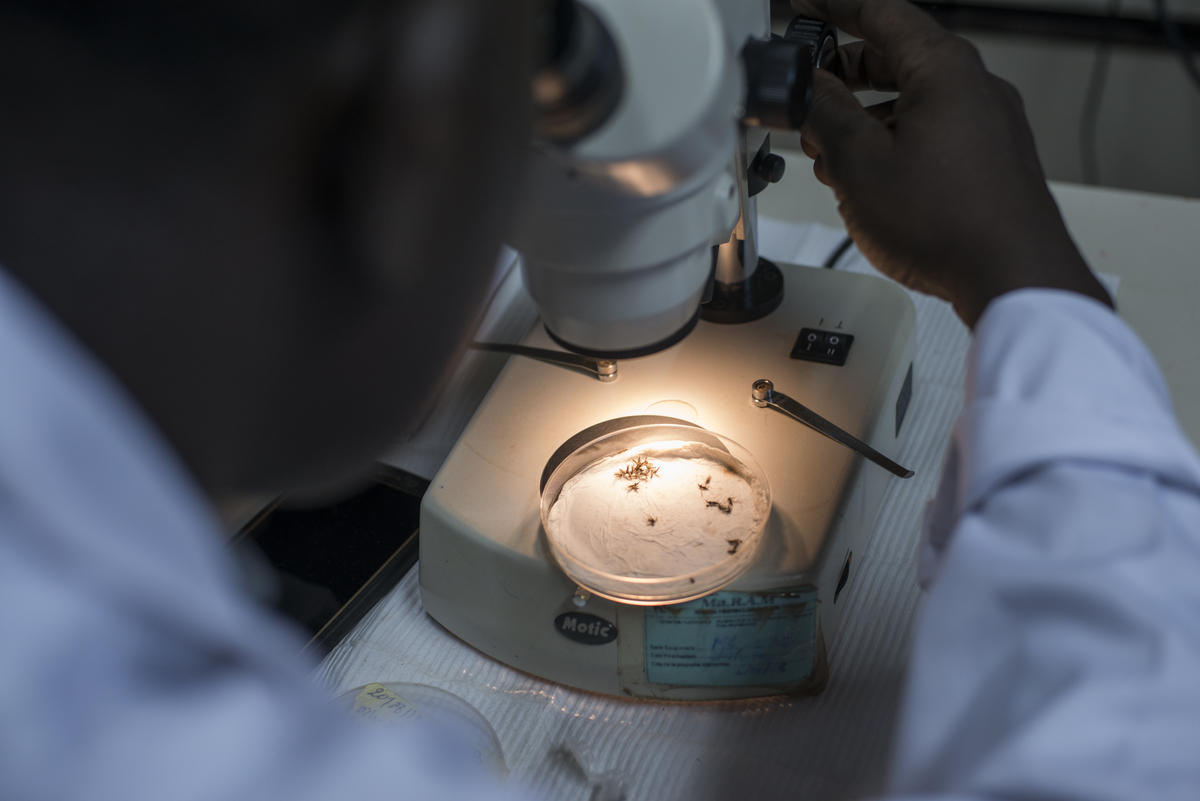
A lab technician categorizes and tests mosquitos for malaria infection in Ouagadougou, Burkina Faso.
Photo credit: The Global Fund
Following the loss of U.S. government funding in 2025, Bishop Matsolo’s organization regrettably reduced its staff from 72 to just five, sharply constraining its ability to serve communities across a large and high-burden country. Bishop Matsolo emphasized that this has led to a scaling back of community-based prevention and surveillance. Outreach efforts led by trusted faith actors have been scaled back at a critical moment, increasing the risk of malaria resurgence and leaving vulnerable populations with fewer pathways to lifesaving care.
Both Bishop Matsolo and Amu Mudenda, regional coordinator for Faith Leader Advocacy for Malaria Elimination (FLAME), emphasized that one of the most effective ways to prevent backsliding in the progress against malaria is to ensure faith-based organizations are fully resourced and meaningfully included in national malaria planning. Because malaria primarily impacts the most vulnerable segments of society, faith leaders, who are deeply connected to local and rural communities, should be included in conversations between donor and recipient governments.
In Zambia, where faith-based providers account for roughly 40% of total national health care services and more than 50% of rural health services, Mudenda describes the central role of faith leaders in frontline care delivery. He explained that faith leaders not only help national and provincial governments optimize resources, but they also inform governments of homes or communities that have been missed, ensuring that no one is left behind.
Mudenda cautioned that when these trusted community actors are under-resourced or excluded from decision-making processes around resource allocation and program implementation, they risk not only reduced effectiveness, but also the erosion of community trust that is essential to sustaining malaria control efforts.
Despite being one of 11 African countries bearing the highest malaria burden and among the top 5 globally in incidence, Mozambique had already begun to make significant gains in reducing malaria. In recent years, the number of new malaria cases registered in health facilities has decreased by 12%, and malaria-related deaths have dropped by 4%. Yet as Bishop Dinis Matsolo, Executive Director of the Inter-Religious Platform for Health Communication (PIRCOM), explained, recent funding cuts have placed that fragile progress at risk.
Eliminating malaria is not a question of possibility, but of consistent commitment, requiring more contextualized and country-driven approaches that reflect the realities on the ground.
Maelle Ba, communications and external affairs advisor at Speak Up Africa and a leader within the RBM Partnership to End Malaria, framed this moment as one of both risk and opportunity. The risk, she noted, lies in losing focus on malaria at a critical juncture. The opportunity lies in approaching the transition with honesty, reassessing what has worked and strengthening efforts through collective reflection.
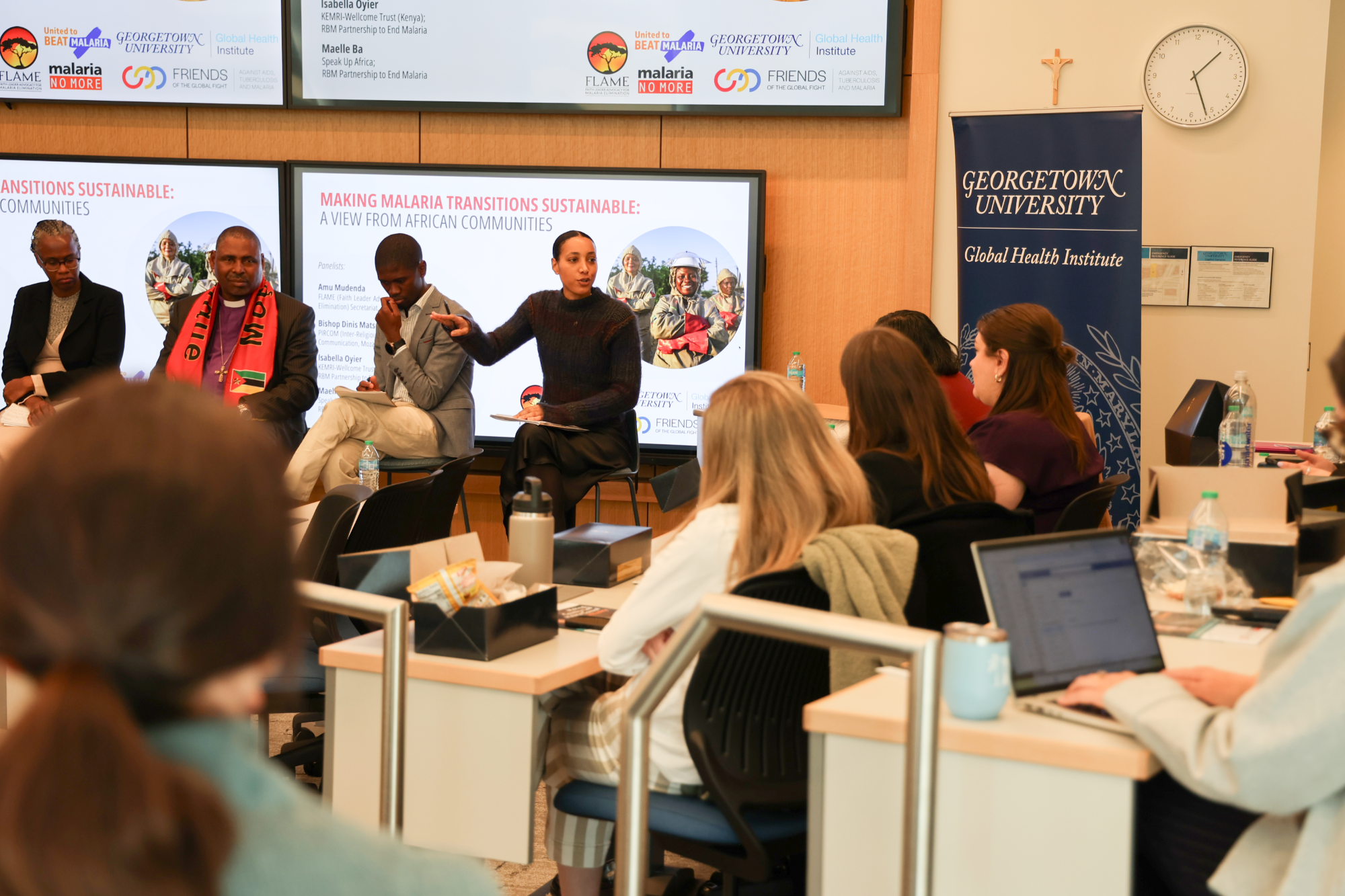
Maelle Ba and other panelists answer audience questions. Photo credit: Georgetown University Global Health Institute
Ba pointed to the role of civil society across the continent in driving a successful transition, ensuring that everyone understands they have a role to play in eliminating malaria, from heads of state to local communities and schoolchildren. Initiatives such as the Zero Malaria Starts with Me campaign, a continent-wide movement endorsed by the African Union to mobilize political will, community engagement and accountability, demonstrates how country-led movements can translate promise into action.
As malaria remains overwhelmingly concentrated in Africa, Ba emphasized that the response must be rooted in African leadership, expertise and solutions. She described the Accra Reset, an African-led call to increase domestic financing for health, as a pivotal moment in this shift. Ensuring that transitions are not merely symbolic requires real accountability, sustained prioritization and adequate financing, alongside intentional efforts to create space for civil society and the African diaspora to shape decision-making and reframe the global narrative.
As the U.S. continues to sign and implement bilateral health agreements under its America First Global Health Strategy, the stakes for malaria transition are becoming clearer. These agreements, often five years in length, are designed to shift greater financial responsibility to partner countries, but in practice may entail steep year-by-year reductions in U.S. support and cuts to malaria-specific funding.
On December 4, 2025, Kenya became the first African country to sign a five-year, $2.5 billion health agreement with the United States and Mozambique followed days later with its own agreement. Yet these agreements are moving forward with steep co-financing requirements even as many of the countries involved, including Mozambique, Zambia and Senegal, face moderate or high risk of debt distress. A sustainable malaria transition will depend on continued U.S. leadership and ensuring that those closest to the challenge, including faith-based implementers and civil society, are at the center of the response.
This discussion at Georgetown was part of a broader week of peer learning and advocacy on Capitol Hill as part of Friends’ Health Education, Advocacy and Learning Series (HEALS), which strengthens shared learning among global health advocates.
Isabella is Advocacy Manager at Friends of the Global Fight Against AIDS, Tuberculosis and Malaria.